We're proud to have had 10,000 views to Two Years in the Making! One of the three goals of Peace Corps Romania is to promote a better understanding of Romanians on the part of Americans. We're proud to say that we've done this and more. People from 65 countries have read our stories. Who knew so many people would be interested in our Romanian adventure?
I'm also gratified that our most popular post, Orange Curtains and Red Pleather has earned us the first page when you google "orange curtains." Try it!
One of the highlights of our summer was being included at the wedding of Vic and Bianca, part of our adoptive Romanian family. Weddings here are a 24 hour affair and include a lot of traditions. Here are a few.
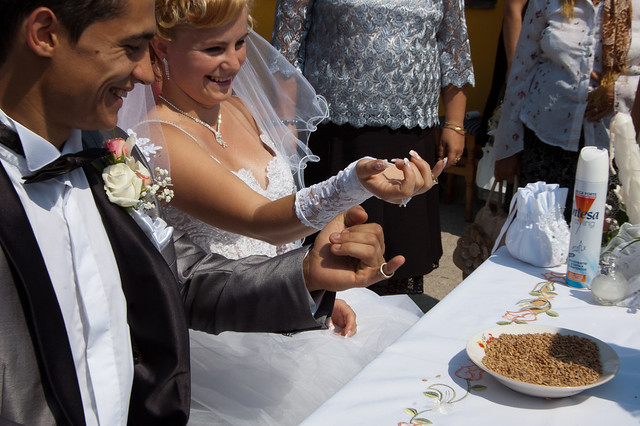
The wedding day starts with a small party at the bride's house. The bride and grooms' rings are put in a bowl of wheat grain. The grain represents abundance for the couple. The bride and groom search for their rings using their pinky fingers. The one who finds his or her ring first will be the most hardworking of the couple. It seems to me it would be better not to find your ring!
Vic and Bianca find their rings.
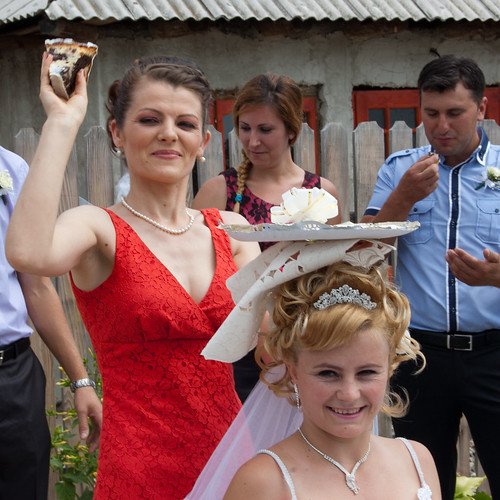
In Romania, the bride and groom have spiritual godparents. Our closest friends, Lucia and Cristi, were Vic and Bianca's godparents. In this picture, Lucia is making the sign of the cross while holding a special bread (called colac) over Bianca's head. She then throws the bread in each direction of the cross. This foreshadows the wedding ceremony when the priest will crown the bride and groom. The throwing of the bread shows the bonds between the family and the couple. It meant a lot to me that I was one of the people to whom the bread was specifically thrown.
Lucia throws the bread over Bianca's head.
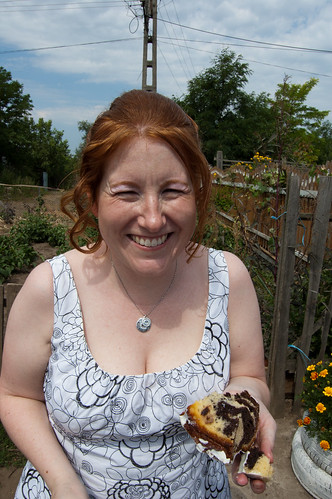
Sarah catches the bread.
After this first party, the family goes to the mayor's office to make their wedding official. There's another small party there. Then everyone goes to the church for the religious ceremony.
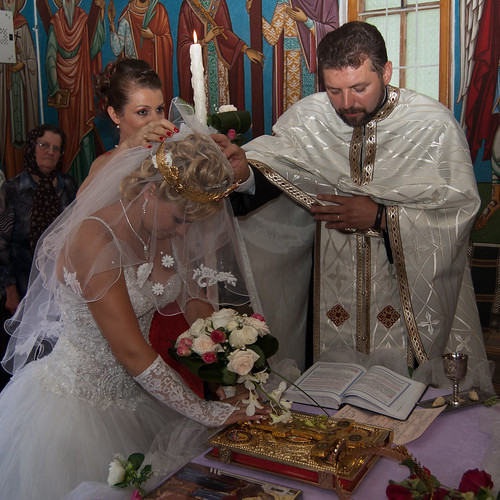
Bianca is crowned by the priest and Lucia, her godmother.
As part of the wedding ceremony, the couple, the godparents, and the priest dance a traditional Romanian dance (horă) around the altar three times. If the bride steps on the groom's feet, she will be the head of the household. If the groom steps on the bride's feet, he will be the head of the household. Bianca stepped on Vic's feet three times! No one was surprised.
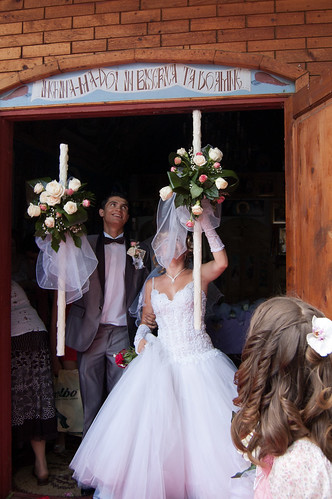
When the couple leaves the church, they carry large candles which burned throughout the ceremony. They extinguish them on the top of the door frame. The goal is to extinguish the candles at the same time, because the person who extinguishes his or hers first will be the first to die. Again, I'm not really sure being first is ideal.
Vic and Bianca extinguish their candles.
Around 9 pm, the reception begins. Interestingly, there's no expectation that guests go to both the ceremony and the reception. It is more common for people to just go to the reception. It includes a five course meal with dancing between each course.
Towards 2 am, the bride is stolen by friends. (They don't have groomsmen and bridesmaids here.) I seem to remember that my parents were stolen at their wedding, so I'm guessing this custom is also Czech/German/Polish. In order to rescue the bride, the groom must drink champagne from the bride's shoe.
Vic drinks champaign from Bianca's shoe.
Towards the end of the reception (about 5 am), the bride's veil is removed and replaced by a headscarf. This symbolizes her transition from a "Miss" to a "Mrs." In the countryside, married women still wear headscarves. In Romania, they also throw the bouquet, but both unmarried guys and girls can catch it. The bride's brother, Alin, caught the bouquet this time around. He and his girlfriend, Roxana, are considered the next in line to be married. To symbolize this, Bianca's veil was put on to Roxana and Vic's boutonniere was pinned on Alin. We'll see if they're really next!
Alin and Roxana receive their boutonniere and veil.
Theron, a fellow Peace Corps Volunteer Stephen, and I were lucky enough to spend a few days in Breb, Marămereș, Romania. Breb is a small village where people still wear traditional costumes on Sunday. Our favorite adventure involved a visit to the local woodcarver, Pop Pătru. I met him by accident at our small hostel and invited ourselves to visit him the next day. In typically welcoming Romanian fashion, he replied, "Vă așteptăm!" which literally translates to "I am waiting for you!"
So, the next day we ventured out to find his house. The directions were pretty vague, "Go that way and then ask someone where his house is." We eventually found it, but when we arrived, no one was there. After a few minutes an ancient, stooped-over woman walked across the yard with her cane. Then out came an old man with holes in his shoes, tattered clothes, and a ratty old straw hat with a Marlboro ribbon above the brim.
Pop Pătru, Breb, Romania
Pop Pătru and his wife led us to their workshop. She makes amazing wool blankets from yarn she spins by hand (without using a spinning wheel) and then weaves (using a loom that for some reason includes chicken bones). According to Mr. Pop, these blankets are so warm, they will make you sweat even in the winter.
He then showed us some of his carvings. He was hardly modest, claiming that he was born with a wooden spoon in his mouth! His boasting had merit - we had already seen one of his most amazing works: the wooden gate to the church. In his workshop we saw crosses, spoons, ornate tools for spinning yarn, and stamps used for consecrating bread in the Orthodox church. We were glad to hear that his son and grandson are carrying on the carving tradition.
Today was another great day in the countryside. It's my favorite place to be in Romania. We are so welcome there that it doesn't matter if our comprehension plummets as soon as we cross the city line. Sometimes truth here is stranger than fiction; sometimes what we understand in Romanian seems like fiction, and we have to double check to make sure we got it right.
As we were wandering through the garden and learning the names of the plants, Theron saw what he thought was a marijuana plant. After many jokes and a lot of explanation, we realized it was actually a hemp plant. The fibers are used to make traditional Romanian costumes. Even more amazing to us, the seeds are used to make a special Christmas dessert called Jesus' Diapers (Scutecele lui Iisus). This time we triple checked.
The school year is over and I'm finally writing my first post about teaching English in Romania. I haven't written yet because my thoughts have been too muddled. The transition from being the person helping the teachers to the person helping the students has challenged most of what I thought I knew about education. I've done things in my classroom this year that would make my educational heros cringe. Plus I've struggled to operate within the Romanian education system which has some practices and assumptions that conflict with my values and knowledge about teaching and learning. Still, I must have done something right. An eighth grade student wrote this and read it at his class graduation.
You meet in life people with whom you bond above words, people that see in you much more than you see, and make the decision to work with you until you discover that part of you that you didn't even know was there. These people are made for your soul and one of them is my English teacher, a teacher that managed to reach to our souls by her way of being open, amusing, and understanding. I wish that all of your days in life are special and the days at school are like holidays. With respect, admiration, and friendship, Yours truly, Palade Valentin and Class 8B
I'm proud that my belief in the potential of each student has shone through the fog of this year. My year in Romania has been worth it.
I want to brag about my wife for a little bit. She's an incredible teacher because she believes that her students can and will excel. She trusts them, and therefore she gives them challenges and opportunities that other people don't even imagine are possible.
The Peace Corps has given us the option to create small group Romanian language weekends. If we want to participate, we think of a creative idea, design a curriculum, and find a teacher. Then we invite other volunteers from our region and the Peace Corps pays for travel and expenses. Past weekends include touring the Bucovina monasteries and learning to cook various Romanian dishes (all while speaking Romanian, of course).
But I think Sarah has had the most inspired idea yet. She decided to turn the tables and ask her students (ages 13-14) to teach us.
There are so many beautiful things about this idea. Many students are smart and hard-working, but may not be comfortable in English. This gives them the opportunity to interact with their teacher and other Americans in a new way. It also gives students an opportunity for leadership. If they're thinking about a career in education, it translates directly, but this kind of experience is useful for almost any job.
One of the biggest lies we tell children, through words but mostly through deeds and attitude, is that we know better than they do. My favorite thing about this experiment is that it gives the students the opportunity to be experts in a subject where adults aren't.
Seven American volunteers visited for the weekend and a total of 10 student teachers worked in groups to teach thirty to sixty minute lessons. Topics included adjectives, summer vocabulary, music, dancing, touristic places, and holidays. The kids have been learning more than just English from Sarah as well. The classes were dynamic and the pacing of lessons was excellent. We played games like Bingo and a cool trivia game called Zong. And, the teachers always asked if we understood the material and patiently answered questions. The bonus - we got prizes! They know how to motivate!
In the end, the project was a huge success, and I think it would be easily repeatable. Way to go Sarah and way to go to our awesome student teachers!
How many times a day do you think you ask the question, "How are you?" I'd estimate at least 20: every phone call you make, each coworker you see, and don't forget the barista at Starbucks.
Well, after being in Romania almost a year, you would think I would be proficient at such a simple question. The problem is that the question "How are you?" literally translates to "What are you doing?"
It's an acceptable answer to say that you're doing well, but it is much more common for people to explain exactly what they are doing at that moment. For example, people will tell you they're at work (while you're talking to them in the teacher's lounge), they'll tell you they're talking (meaning to you), and they'll even tell you they're in the bathroom if you happen to meet them while washing your hands. I still haven't figured out what I'm supposed to say in response to their answer..."Wow! That's funny, I'm in the bathroom, too!"
For a while I thought of the question as an equivalent of "What's up?" In the States the most common answer to that is, of course, "Nothing!" But, here you're met with blank stares or open shock, as if to say "How could you be doing nothing? Did you stop breathing?"
Then yesterday, the inevitable happened. I asked someone "What are you doing today?" expecting them to tell me their plans for the day. But what response did I get? "Good!"